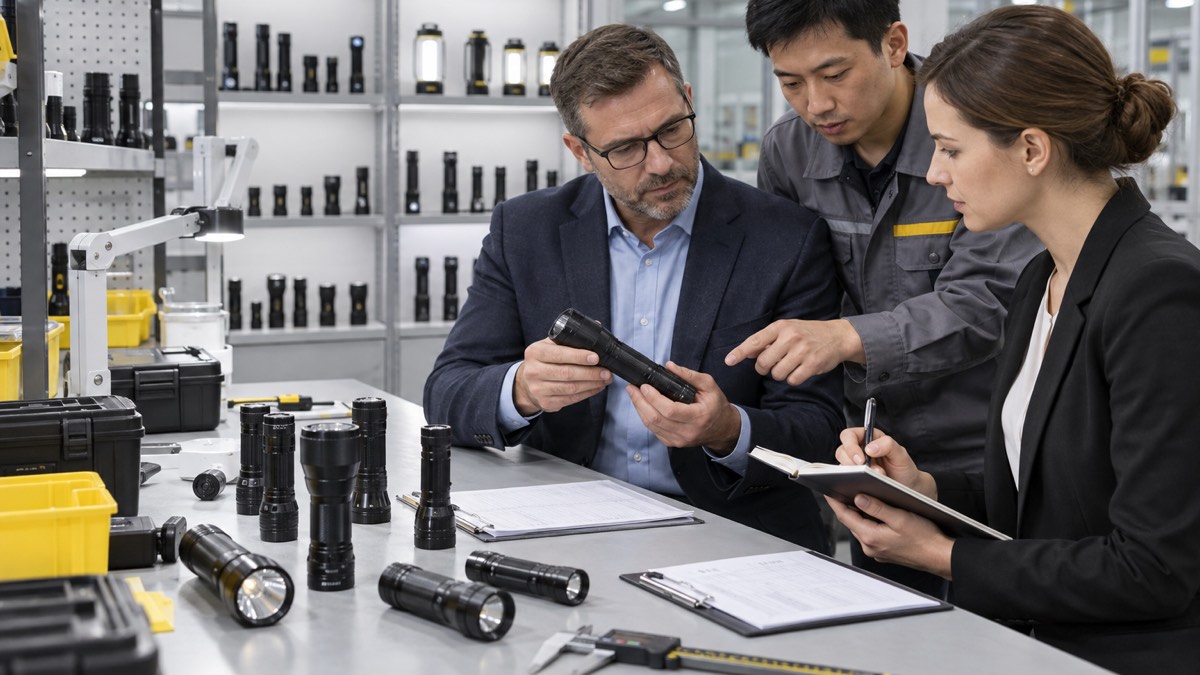
Learning how to find a flashlight manufacturer is less about collecting the most supplier names and more about creating a repeatable verification process. This guide shows buyers how to define a product brief, shortlist factories, check evidence, evaluate samples, compare quotations, and control risk before a bulk order.
A polished website or trade-show booth can help you discover a candidate, but it does not prove manufacturing capability. Likewise, a low quotation does not show whether the battery, LED, driver, housing, seals, charger, packaging, and inspection plan will remain consistent from the approved sample to production. Treat supplier selection as a sequence of evidence-based gates.
1. Define the flashlight before searching for a factory
Manufacturers can only quote accurately when the requirement is clear. Start with the user, environment, performance priorities, target market, packaging, quantity range, and expected launch date. Separate required features from preferences so suppliers know where alternatives are acceptable.
- Product format: handheld flashlight, headlamp, work light, inspection light, lantern, or another defined format.
- Use environment: indoor, outdoor, wet, dusty, cold, impact-prone, or hazardous conditions.
- Performance: beam type, output modes, runtime at each relevant mode, charging method, controls, and mounting.
- Commercial scope: estimated order quantity, target market, packaging, branding, accessories, and documentation.
- Acceptance evidence: drawings, approved sample, test method, inspection plan, and golden-sample control.
If you are sourcing for logistics operations, the warehouse portable work light guide provides an example of turning a use case into measurable sample requirements.
2. Build a broad list of flashlight manufacturer candidates
Use more than one discovery channel. Search engines and B2B directories are efficient for building a long list. Trade shows make it easier to compare samples and ask technical questions. Referrals from testing laboratories, component suppliers, logistics providers, and experienced buyers can reveal capable manufacturers that invest less in advertising.
At this stage, collect comparable facts rather than choosing a favorite. Record the legal company name, website, location, product focus, contact, claimed certifications, stated customization scope, and the source of each claim. Keep screenshots or documents with dates because listings and claims can change.
3. Confirm whether you are speaking with a factory or a trading company
A trading company is not automatically a poor choice. Traders can consolidate products, communicate well, and manage smaller programs. The important issue is transparency: you need to know who controls production, engineering changes, test records, and corrective actions.
- Ask for the legal business name on the quotation, bank account, certificate, and invoice.
- Request a live video walkthrough that follows material receipt, assembly, testing, packing, and storage.
- Ask which processes are performed in-house and which are subcontracted.
- Compare factory signage, employee uniforms, product labels, and document names for consistency.
- Confirm who owns tooling, approves component substitutions, and signs corrective-action reports.
4. Shortlist suppliers with a standard questionnaire
Send every candidate the same concise questionnaire. Consistent questions make answers easier to compare and reveal which suppliers can communicate clearly before an order becomes complicated.
| Area | Questions to ask | Evidence to request |
|---|---|---|
| Product fit | Which similar product families and processes do you handle? | Current catalog, process list, and relevant sample |
| Engineering | Who reviews drawings, batteries, drivers, optics, thermal design, and changes? | Specification review and change-control example |
| Quality | What incoming, in-process, and final checks are performed? | Inspection plan, records, equipment list, and defect handling |
| Capacity | What is the normal and peak capacity for the quoted configuration? | Production plan and lead-time assumptions |
| Compliance | Which requirements apply to the exact product and destination? | Current reports and declarations tied to the model |
| Commercial terms | What affects MOQ, tooling, packaging, price, and lead time? | Itemized quotation and written assumptions |
5. Verify company and quality-system evidence
Check business registration and the identity receiving payment using official sources available in the supplier’s jurisdiction. If a supplier presents an ISO 9001 certificate, verify the certificate number, issuing body, validity dates, site address, and scope. A certificate with an unrelated scope or address does not answer whether the quoted flashlight is controlled at the stated facility.
ISO’s supplier guidance distinguishes supplier declarations, customer assessments, and third-party certification as different ways to gain confidence in a quality management system. Certification can support a supplier review, but it does not replace product-specific testing, sample approval, or production inspection.
6. Ask for product-specific test reports
Do not accept a folder of unrelated certificates as proof. Each report should identify the product, configuration, test method, laboratory, dates, results, and any photos or model references needed to connect the report to the quoted item.
For portable lighting performance, the ANSI/NEMA FL 1 standard provides common test methods for areas such as light output, runtime, beam distance, impact resistance, and water resistance. Ask whether claims were measured using a recognized method and whether the report covers the exact battery, driver, LED, optic, and housing you will buy.
Regulatory requirements depend on the product and destination. For example, the EU RoHS Directive addresses restricted substances in electrical and electronic equipment. Determine the requirements for your market with qualified compliance advice, then request the correct technical evidence. A CE, FCC, RoHS, IP, or other logo by itself is not a test report.
7. Evaluate flashlight samples against a written plan
A sample should answer a defined question. Mark every sample with the supplier, model, configuration, date, and revision. Record results instead of relying on impressions, and keep the approved sample as the production reference.
- Confirm dimensions, weight, finish, labels, accessories, packaging, and user instructions.
- Measure output and runtime using the agreed method and operating mode.
- Assess beam shape, color consistency, controls, memory behavior, and low-battery indication.
- Check charging behavior, connector fit, battery protection, and temperature under expected use.
- Perform the environmental and mechanical tests required by the product brief.
- Disassemble a sample when appropriate to document critical components and workmanship.
- List every deviation and require written approval before any substitute enters production.
8. Audit the processes that control repeat orders
A factory audit should follow the product through the real process. Review incoming material identification, battery storage, soldering and assembly controls, programming or driver checks, sealing steps, test equipment calibration, nonconforming material, final inspection, packing, traceability, and corrective action.
Pay close attention to change control. Many problems occur after a good sample is approved because a cell, LED, driver, seal, adhesive, charger, or housing material changes without the buyer’s knowledge. Your purchase specification should define which components are critical and require written approval for substitutions.
9. Compare quotations on the same basis
A useful request for quotation makes inclusions and assumptions visible. Ask suppliers to separate product price, battery, charger, accessories, packaging, printing, tooling, testing, inspection, and freight terms. Confirm the Incoterm and named place, currency, payment schedule, sample charges, production lead-time assumptions, quotation validity, and warranty process.
Do not compare two unit prices until both cover the same specification and commercial scope. A cheaper quote may exclude testing, packaging, accessories, tooling, or the battery configuration assumed by another supplier.
10. Place a controlled pilot order before scaling
When practical, use a pilot order to validate communication, material control, production consistency, inspection, packaging, and logistics. Define acceptance criteria before production starts. Arrange pre-shipment inspection at the agreed stage and make sure the inspector has the approved sample, specification, packaging artwork, and defect rules.
Flashlight manufacturer red flags
- The legal company name changes between the quotation, certificate, invoice, and bank account without a clear explanation.
- The supplier refuses to identify the manufacturing location or subcontracted processes.
- Test reports show a different model, address, applicant, configuration, or expired scope.
- Performance claims are presented without a test method or report.
- The sample specification stays vague while the supplier pushes for a deposit.
- The price changes sharply without a documented change in specification or commercial terms.
- The supplier will not agree to written approval before critical component substitutions.
Frequently asked questions
Where can I find flashlight manufacturers?
Use several channels: targeted web search, B2B directories, lighting and hardware trade shows, industry referrals, testing laboratories, and component suppliers. Discovery is only the first step; verify every candidate using the same questionnaire and evidence requirements.
How can I tell whether a supplier is a real factory?
Compare the legal entity across registrations, quotations, bank details, certificates, and invoices. Request a live process walkthrough, identify in-house and subcontracted steps, and confirm who controls engineering changes, quality records, and corrective action. A third-party audit can provide stronger evidence when the order justifies it.
What should I ask a flashlight manufacturer for?
Ask for a model-specific datasheet, sample, drawings where appropriate, bill-of-material controls, test reports, quality plan, change-control process, itemized quotation, MOQ, lead time, packaging details, and written warranty handling. Tailor compliance documents to the destination market and exact configuration.
Should I choose the manufacturer with the lowest MOQ?
Not automatically. MOQ should be considered with product fit, sample quality, tooling, component availability, test evidence, communication, change control, lead time, and total landed cost. A manageable pilot can be valuable, but only when its specification and acceptance criteria are controlled.
Does ISO 9001 certification guarantee flashlight quality?
No. ISO 9001 addresses a quality management system. Verify the certificate and its scope, then continue with product-specific specifications, sample testing, production controls, and inspection.
Turn your search into a supplier qualification process
The best flashlight manufacturer is not simply the factory with the largest catalog or lowest opening quote. It is the supplier that can understand your use case, document the agreed configuration, produce repeatably, provide relevant evidence, communicate changes, and support the commercial scope of your program. Use the steps above as a qualification checklist, then continue exploring practical sourcing guidance in the Flashlight Bulk blog.
Sources: ISO supplier confidence guidance; ANSI/NEMA FL 1; EU RoHS Directive.